Some time back my daughter’s Mathematics teacher had called us to express her concern about her efforts in the subject. She felt that since she has not taken up science she is not giving enough importance to mathematics.
That set me to thinking – do only those students need to study maths who plan to become engineers or accountants? My daughter has taken humanities for her plus 2 and her interest is in English literature, Psychology and Sociology, which is what she had opted for. Maths was always going to be an extra subject, but it set me thinking. I had always liked Maths as a subject and had always performed well in it. But the real beauty of Maths was discovered by me when I started reading about it after school and collage.
There are two views on the subject of mathematics.
First says that it is a wonderful tool that enables us to study the universe. It may be in its macro application of large length of numbers which allow us to study and make sense of galaxies and black hole and distances in light years. Or it may be its micro level avatar which allow us to think of and discover subatomic particles like electrons and quarks. Or an everyday scale, it allows us to -build a stronger building, faster computer or even study the spread and control of an epidemic.
Second view of Mathematics is that, first and foremost it is a thing of beauty- an art form. This is what propels so many people to spend a lifetime studying it for its own sake. For them it is the universal language through which everything can be made sense of. The brilliance of patterns within creation of life itself. The elegance of ideas involved in understanding the truth held within our mind. For them it is the language in which, God has written the rules of life and creation, and they are fortunate enough to glimpse the divinity by grasping and understanding Mathematics.
But this is a small majority.
There is a reason very few of us see this ‘Beauty’. For most of us our view on mathematics is formed from our exposure to it in school. And in School it is taught as a tool that will be used in engineering or science. A lot of high school mathematics consist of manipulating symbols and practicing formulas, without going deeper (The “How to” instead of “Why”). To be fair to our education system it would be unfair to blame the schools for this.
Firstly school system prepare students for a vast variety of profession, most of which will be using maths as a tool(the “How”). Secondly it is very difficult (but not impossible), to communicate the beauty of maths whithout adequate grounding in the basics.
For students with an artistic bent of mind, who gravitate towards humanities, this method of teaching can be -at least bewildering or at most traumatic. For many of them this has lead to a lifelong fear and resentment of the subject. Which is a pity because as stated earlier Mathematics is ultimately an Art.
Perhaps we have lost the opportunity in School, but my daughter will be going to collage next year and perhaps will be exposed to some form of Mathematical appreciation course. Perhaps the beauty of number system will be revealed to her. May be she will understands that symmetry and art own a debt to mathematics. Maybe I will be able to explain to her how questions arise naturally in mathematical reasoning, and attempts to answer them reveal deeper and deeper meaning and sharpens your mind like no puzzle or riddle.
When I started working was the time I started reading about mathematics to answer a few questions I had read about, or found reference to, in some books or articles. This was the time I realized that mathematics could actually be interesting. There were so many interesting discoveries and revelations. I will list a few here.
Their exists in abstract algebra, object called groups that helps make sense of symmetry. A symmetry group is the collection of all ways to move the pattern around, such that it leaves the pattern unchanged to naked eye. To witness this I would suggest a walk to your bathroom to see the tiles. If you rotate your tile pattern and it remains unchanged that is a demonstration of rotational symmetry. The angle of rotation may vary and smaller the angle of rotation for which the symmetry holds more difficult it is to design this pattern (keep this in mind when you are analysing the prices of the tiles). A wall made of tiles which can be moved horizontally and vertically without changing the pattern demonstrates translation symmetry.
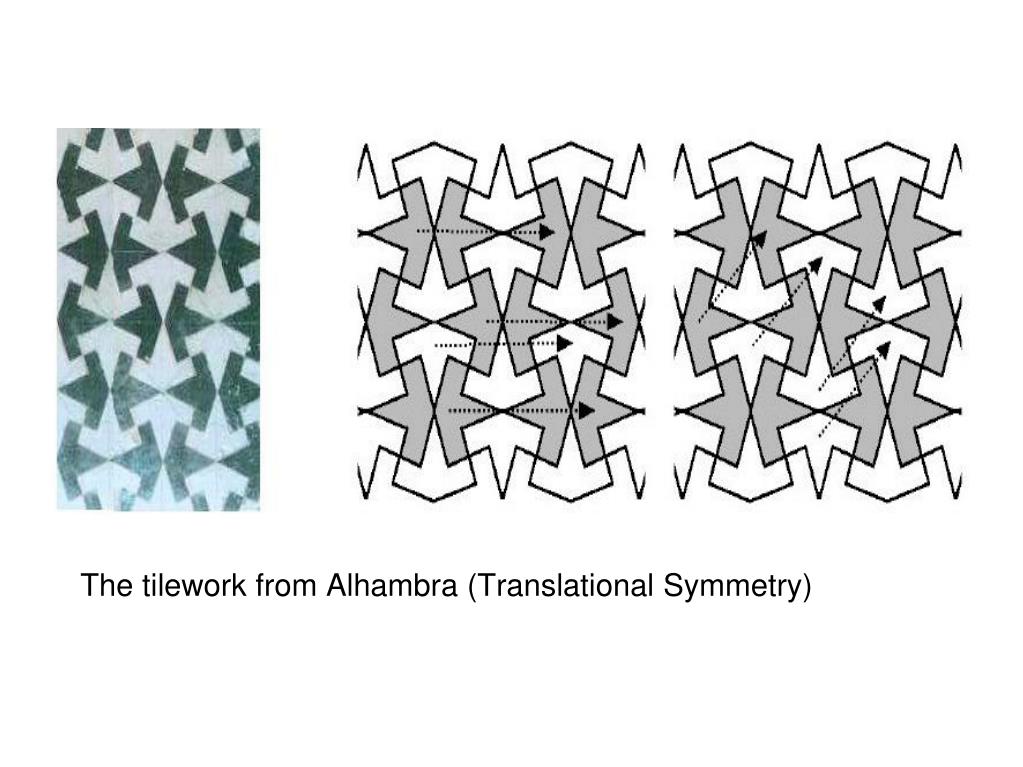
If you can appreciate this then you can also appreciate and understand the patterns thrown up by nature: arrangement of petals in a flower, shape of jelly fish floating in your aquarium, the pattern of the branches in your potted plant, as they grow to maximize their exposure to sun.
We all know that the sum of three angles in a triangle is 1800 , but this is true only for Euclidean geometry. In Spherical geometry the sum of three angles is more than 1800 , while in hyperbolic geometry the same is less than 1800. Many years ago I had come across the work of M C Escher in an exhibition in London. His work was in inescapably mathematic. His primary work was as a printmaker so his work contains several example of hyperbolic geometry.
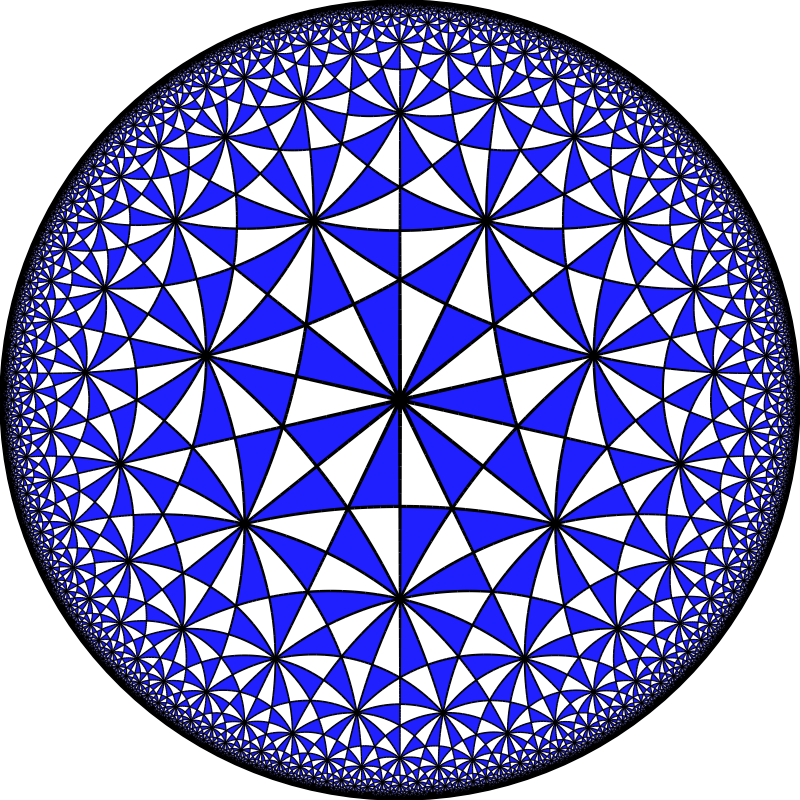
Above is an example of his fascinating work. The various curved triangle are hyperbolic and thus have the same area. Even though they appear to be getting smaller as we move from the centre to the circumference they are all congruent to each other.
There are so many examples of my journey towards the discovery of the joys of Mathematics. But some day I hope that this beauty can be imparted to the non-science students. I hope they use mathematics to showcase the elegance of arguments, depth of their understanding of concepts. They understand the value of constantly questioning your assumptions, and the power of imagination as well as reasoning, and finally the far reaching consequence of having abstract thoughts and learning to articulate them.
By the way I hope they also realize that Maths can also be FUN.

 People & Society
Leave a reply to Aakash V Sahai Cancel reply